
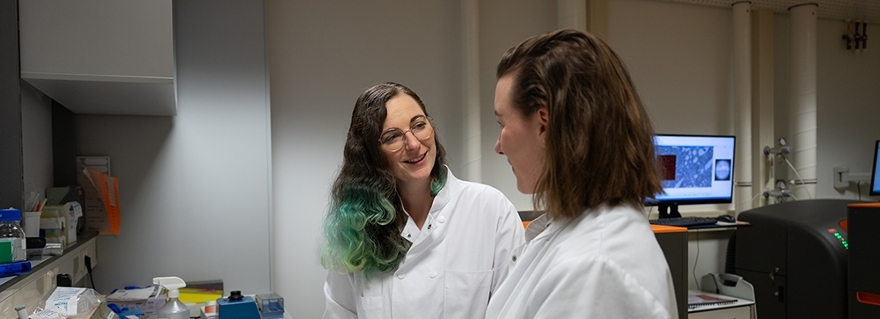
A new perspective on aggressive pancreatic cancer
The figures are stark: each year, more than 500,000 people worldwide are diagnosed with pancreatic cancer. The most common and aggressive form, pancreatic ductal adenocarcinoma (PDAC), has a five-year survival rate of less than 10 per cent. LUMC researcher Marieke IJsselsteijn has developed a new method that allows her to study these tumours in unprecedented detail.
Immunotherapy fails to improve survival
PDAC is often diagnosed at an advanced stage. Although immunotherapy has delivered promising results for several types of cancer in recent years, it has failed to improve the survival outcome for PDAC. One reason is that the cells within and surrounding these tumours vary greatly in their characteristics and undergo profound metabolic changes, making them difficult to identify and study.
Until now, researchers have separated tumour tissue into individual cells. ‘The problem was that you no longer knew where exactly those cells came from. It’s like dismantling a Lego model and putting the bricks back in the box one by one’, says IJsselsteijn. But location matters: cells behave differently depending on their environment.
Combining techniques for new insights
To capture this complexity, the LUMC researchers combined two technologies: imaging mass spectrometry (MS) and imaging mass cytometry (IMC). ‘With MS, we study the metabolism of tumour tissue: for example, how sugars are converted into energy’, says IJsselstein. ‘With IMC, we see not only tumour cells, but also immune cells and how they behave within the tumour.’
The crucial difference is that the researchers now work directly in the tissue itself, without having to take tumours apart.
To combine these two technologies, they first had to address a technical problem: the quality of the tissue deteriorated quickly, making it difficult to integrate MS and IMC. They overcame this by fixing the tissue with a thin protective coating after the first analysis. The main advantage is that they can now study the same piece of tissue twice in succession.
‘This means we can overlay the images produced by the two techniques’, explains IJsselstein. ‘This gives us the complete picture, revealing not just which cells are present but also what they do.’
What is happening in the tumour?
Using this method, the researchers aim to understand why immune cells sometimes fail to reach tumours. Is something happening in the tumour cells to prevent the immune cells from entering? Or do immune cells withdraw because the tumour cells have already consumed all available nutrients?
They will also be able to compare tumours. ‘You can have two tumours that look similar, yet one is far more aggressive than the other’, says IJsselstein. ‘We still don’t know why. Something is missing – probably because we don’t have all the information.’
Towards new treatments
With the LUF grant, the researchers are now investigating why immunotherapy is ineffective in aggressive pancreatic cancer. This could reveal new targets for treatment. ‘Ultimately, we hope this research will contribute to the development of life-saving therapy’, says IJsselsteijn. Given the low survival rate of this aggressive disease, any advance is an important step forward.
Yould you like to help make research such as this possible? Donate a one-off amount or become a structural contributor to the Leiden Universiy Fund. You might also consider becoming part of our Key Family.